
A Sister for a Sister
As the wind gets fiercer, a young woman crosses her arms on her chest. Aldona is standing on the shore of the Lena River, watching the river waves in contemplation. She was passing exams in the Yakutsk University quite recently—she studies biology there, part-time—but now all she can think about is her own students. Before her studies, she graduated from the Teachers' Institute and was assigned to work on the Tit-Ary island, the one that she had been banished to a long time ago. There, a new schoolyear will start soon, but, just moments ago, Aldona had to disembark the barge that was supposed to bring her back to her students.
'At Kyusyur, I was told: “Dalshe neplyvyom” (“We don't go any further” in Russian). However, while standing on the shore, I suddenly noticed familiar faces: Kraujalienė with her son and the German. We saw a large sailboat. We learned that it is going the same direction as us and we asked whether it could take us there: three women and a child,' Aldona Mikalajūnaitė, a lovely woman with silver hair and a closed white shirt, tells us in her apartment in Vilnius.
The story is almost 70 years old; Aldona is 85. She was banished to Syberia when she was ten, but she remembers the events to this day.
Don't be young
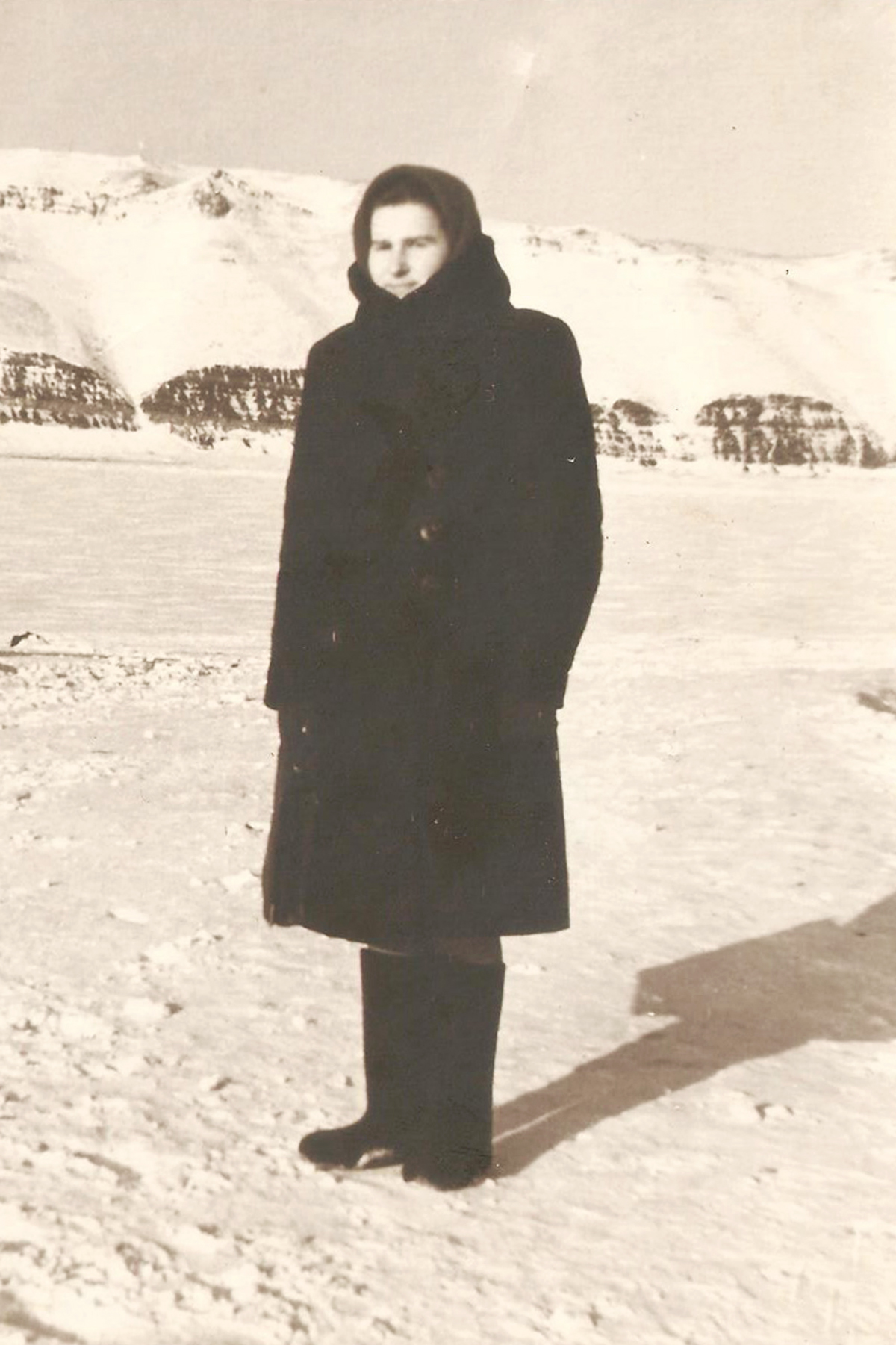 Aldona, 22 years old, poses on the Lena River bank on Tit-Ary Island, 1954.
The crew agreed to take Aldona and her friends to the Tit-Ary island. They even gave them a separate cabin. Aldona was happy to know that she will return in time for the new schoolyear, but later it appeared that it was too early to relax.
'In the evening, Walpurgis Night took place on the ship. A ship mechanic barged in and started yelling: “You have a young lass, let her come to us!” The other women responded that I don't want to go anywhere. The mechanic started banging on the door, threatening us, broke a lamp above the door. Kraujalienė lit up a candle and told me: “Look, we're going to paint you a bit with soot, so that you don't look so young”. And they did so. Then, they sat me in between them and guarded me the whole night,' Aldona laughs in her memories.
She managed to reach the Tit-Ary island peacefully that time. 'We learned how to ignore people like that mechanic. We wouldn't even look at them. Nothing like that has happened to me after that night,' says Aldona assuringly and pauses.
Labour power without power
When she was a little girl in a little village by Anykščiai, Aldona would walk barefoot on the stubbles. After that, she would wash her riven feet in cold water, for her mother told her that that would harden them. When the first wave of banishment came, Aldona, together with her mother and elder sister, were banished to the Altai Region.
Far from their homeland, women had to cut trees (including larches which were in the Red List of Threatened Species), prune branches, and gather three cubic metres of firewood every day. 'Both my mother's and my sister's menstruations dissapeared. My period didn't start until I was fifteen. Well, is there anything else I could say,' Aldona waves it off and goes silent. In a while, she adds: 'I remember the beautiful Laima, who also had to transport those Altai trees. She was seventeen, or perhaps sixteen, when she suddenly dropped on the ice and died right there.'
Little Aldona was alienated from her world and deported to a strange land where different rules applied; for a while, she could not understand that the young were as powerless against death as the elderly. After a year in the Altai Region, her family was moved even futher North, by the Laptev Sea. After her first winter above the Arctic Circle, Aldona would not be surprised by anything anymore: 'Seven to ten people would die every week in the barracks. There was no way to bury them, as it was impossible to dig through the ice. The bodies would be lined against the barracks, just like firewood. We, the children, would pass by the bodies, would see them. And we were not afraid at all.' Aldona's tone is calm, her eyes dry. According to her, in Syberia, each and every thought was about her family's survival: 'At school, I would get a piece of bread with some sugar on it. I'd bring it back home and part it in three: for the mother, for the sister, and for me. We'd not eat a crumb without sharing it. Perhaps that's why we survived.'
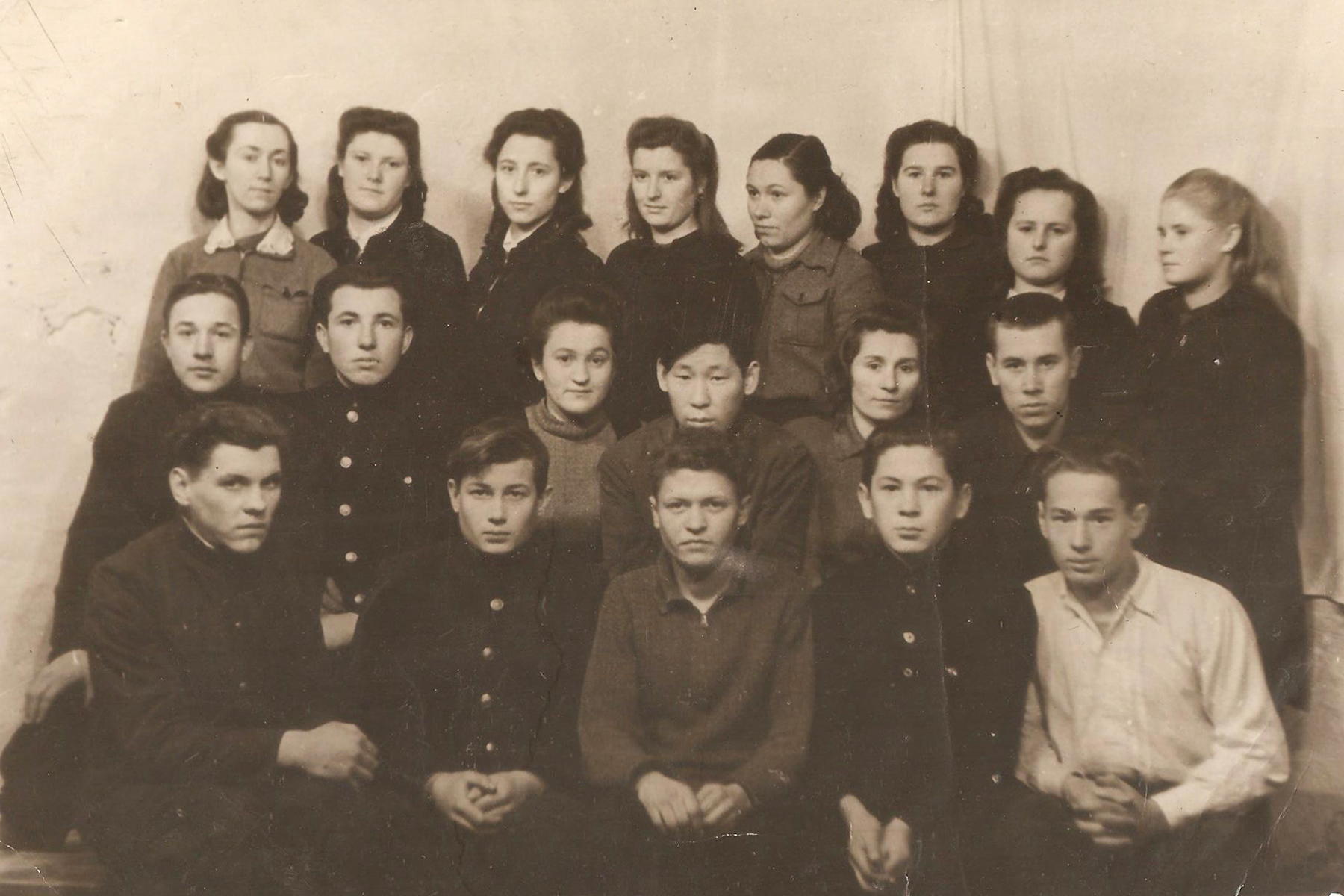 School graduation after 10th grade. Aldona is in the upper row, third from the right. Kyusyur, 1950.
Hundreds of names
Just like most deportees at the time, Aldona's family was not ready for banishment. When the NKVD came, Aldona's mother was gathering strawberies and her father had been out in the fields since the early morning. When she heard a car in their yard, Aldona's mother decided to hide her daughter. Rumours in the village had it that the Communists were gathering children to send them to state home and educate in ways supportive of the regime. Aldona was hid in a bed, under several blankets. After a while under suffocating blankets, she heard her mother calling her from another room.
When she came in, Aldona saw her mother in between two men with guns. Here, she learned the reason behind the NKVD visit. It appeared that her brother was not to be banished and her father was not to be found anywhere, so it was only the women of the Mikalajūnai that would leave for Syberia. 'My mother lost her husband when she was forty-three, and my father lost his wife at forty-two. From then on, they lived separate lives,' says Aldona gloomily. A long time after that, she did meet her father when he visited Lithuania under a different surname; she learned that he avoided banishment by hiding in a haystack in the barn, and later escaped to Poland. According to her, her father had always wanted to reunite with his family. Aldona still calls him daddy.
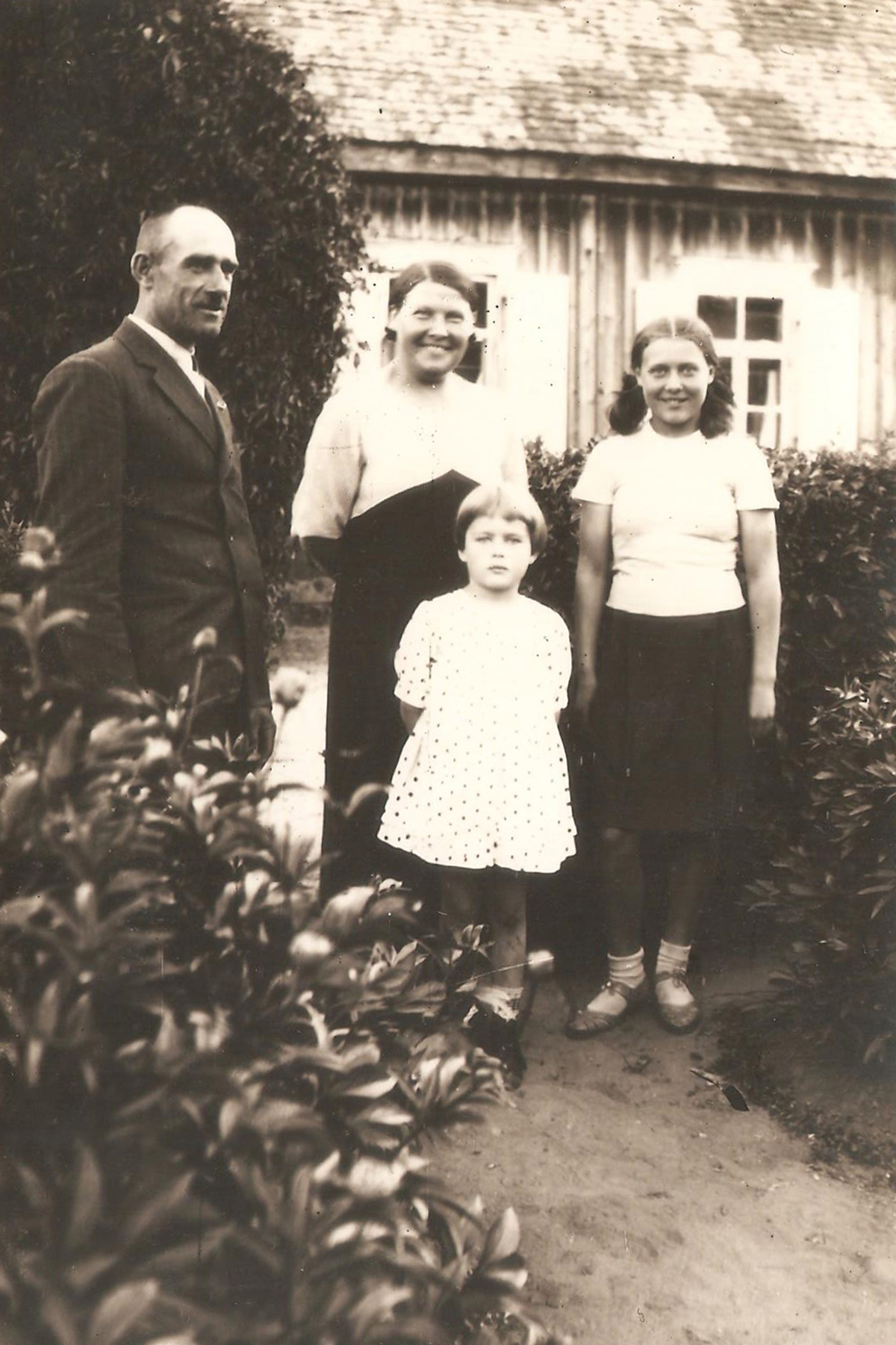 Aldona, 4½ years old, with her family. From the left: her father Stanislovas, mother Teklė and sister Elena. Paulinava, Lithuania, 1937.
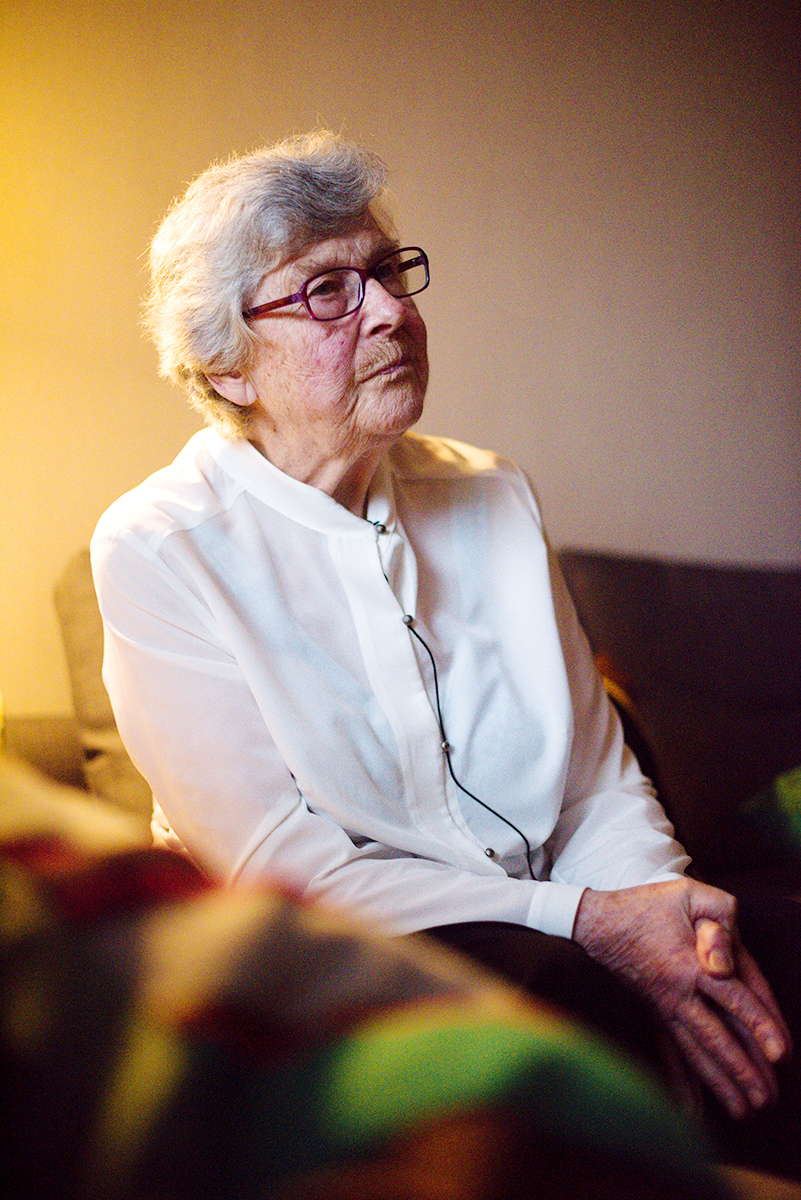 Aldona Markevičienė in her apartment in Vilnius.
Anyway, the three women were left without men in Syberia and had to take care of themselves. 'There was an interesting event. One sister was convicted for stealing a fish, but she was in a very weak state. Instead of her, the other sister went to the Stolby jail. Later, both of them came back to Lithuania. A woman for a woman, a sister for a sister,' smiles Aldona. Of these everyday little heroic deeds in Syberia, she remembers many, but it gets harder and harder to share them. '85 years is a funny number,' says Aldona somewhat ironically. Every year, she loses more and more friends from the young days. Talking about banishment with other people is not easy, since, according to Aldona, not all of them want to believe that the things she tells could have happened in real life. But she does not try to prove them wrong: in Lithuania, Aldona has her own apiary, and she jokes that she cares about the bees more than she cares about the old quarrels. 'Those are memories of a child. But even now I have several hundreds of surnames and fates in my memory. It's not easy to carry this burden. But I'm happy about everything. One needs to know how to live. Simply live,' smiles Aldona, but her gaze remains serious.
